Dr Shane Oliver, Head of Investment Strategy & Chief Economist at AMP, discusses home prices.
Key points:
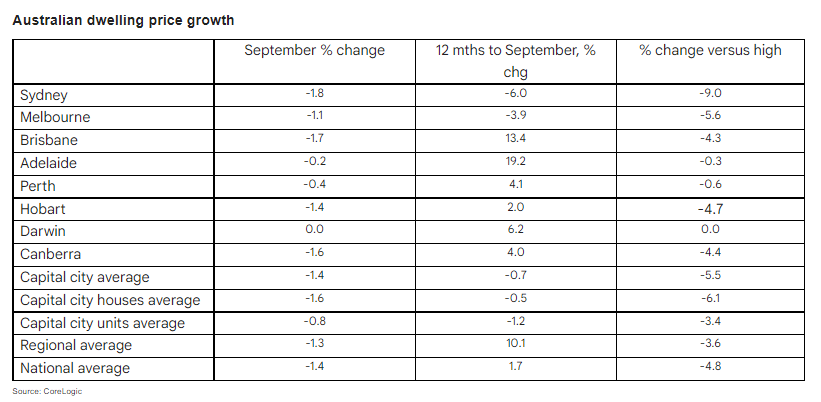
- Australian capital city average dwelling prices fell another 1.4% in September according to CoreLogic, making it their fifth monthly decline in a row.
- Including regional dwellings, which fell another 1.3%, national dwelling prices also fell 1.4% in the month, and their annual growth rate dropped to 1.7%yoy.
- National average prices have had their fastest decline since 1980, reflecting the rapid paced rates hikes at a time of high household debt levels.
- Prices fell in seven of the capital cities, and were flat in Darwin.
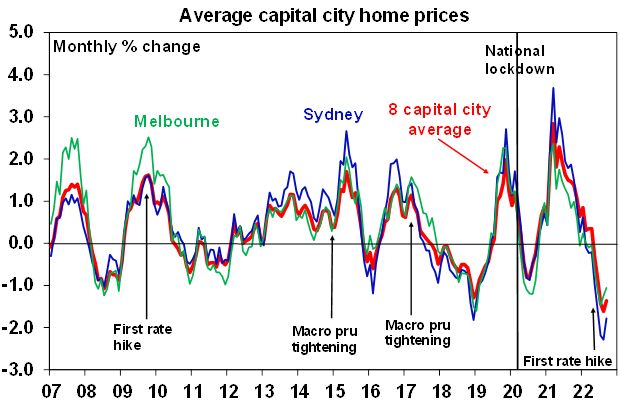
- The monthly pace of falls slowed in Sydney to 1.8% (after 8 months of falls) from 2.3% in August and in Melbourne to 1.1% (after 7 months of falls) from 1.2% in August but this is unlikely to be a sign that prices are nearing the bottom.
- We continue to expect a 15-20% top to bottom fall in average home prices as the full impact of rate hikes to date along with further rate hikes impact and as economic conditions slow sharply into next year.
The property market is losing altitude rapidly
After surging 28.6% between their pandemic low in September 2020 to their high in April national average property prices have now fallen 4.8%. The boom is long over, and price falls have spread from Sydney and Melbourne to other capital cities and regional areas.
The key drivers of the downturn are: poor affordability; rising mortgage rates with fixed rates having gone up three fold from around 2% to around 6% and variable rates now rising rapidly; a rise in new listings in Sydney and Melbourne; a rotation in household spending from goods back to services; cost of living pressures making it harder to save for a deposit; and a collapse in homebuyer confidence.
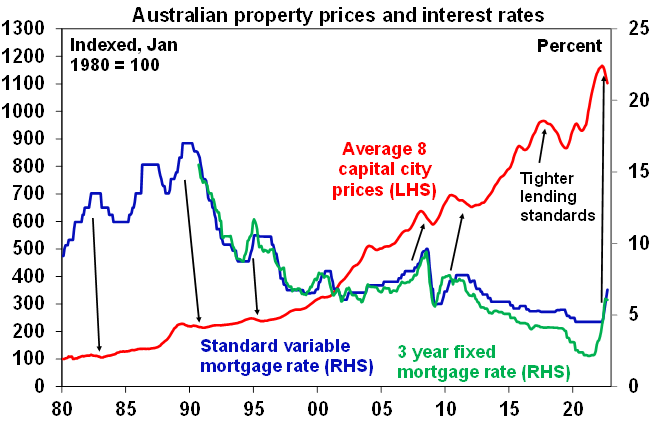
But the main driver of the slowdown so far is the surge in mortgage rates – being able to borrow at a fixed rate of 2% or less was a key driver of the boom in prices with fixed rate lending accounting for around 50% of new lending about a year ago. But with fixed mortgage rates now up three-fold from their lows and variable rates rising rapidly this has substantially reduced the amount new home buyers can borrow and hence their capacity to pay.
While the pace of monthly price declines slowed in several cities including Sydney and Melbourne and for the national average, this likely reflects the market getting used to the initial shock of rate hikes, bargain hunters taking advantage of lower prices and vendors holding off selling with Spring listings of to a slow start. Auction clearance rates have also increased from a low of around 50% to around 60%. But with the full impact of rate hikes to date yet to be felt, interest rates still rising, and the economy set to weaken its unlikely to presage an imminent bottoming in home prices. Past periods of property price falls experienced a few gyrations in the pace of prices declines before prices ultimately bottomed, eg in the 2017-19 down cycle.
Source: CoreLogic, AMP
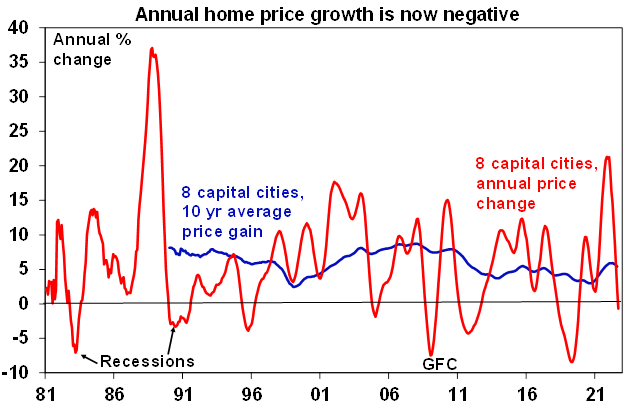
The monthly falls in capital city prices are now seeing annual prices down on a year ago. Simple mean reversion after a period of well above 10-year average growth warns of a further downturn ahead.
Source: CoreLogic, AMP
Of course, average home price levels have still only seen a flick off the top after a huge boom. But further falls are likely. So far national average property prices are down 4.8% from their high over five months – which is the fastest pace of decline since in 1980. The rapidity of the decline in home prices this time around likely reflects the de facto tightening that started with rising fixed mortgage rates a year ago, the speed of RBA cash rate hikes and heightened household sensitivity to rising interest rates flowing from much higher debt levels now.
Source: CoreLogic, AMP
Outlook – we continue to expect average property prices to have a top to bottom fall of 15 to 20%
We expect national average property prices to fall further over the next 9-12 months reflecting: poor affordability; rising fixed mortgage rates; further rate hikes from the RBA pushing up variable rates; high inflation which is making it even harder to save for a deposit; higher supply as we see some increase in distressed sales particularly as fixed rate borrowers roll over to much higher interest rates through 2023 and as the economy slows; and a continuing rotation in consumer spending back towards services as reopening continues which will reduce housing demand.
Assuming the cash rate tops out around 2.85% as we expect then average prices are likely to fall 15-20% from top to bottom with the low likely being reached around the September quarter next year.
Expanded access to home deposit schemes, the Federal Government’s “Help to Buy” scheme, NSW first home buyers swapping stamp duty for land tax next year, the tight rental property market, rising immigration levels and in the case of Brisbane, the axing of the onerous land tax changes in Queensland, will ultimately help to provide a floor for property prices but for now the property market will be dominated by the cyclical impact of rising interest rates.
The main downside risk to our forecasts would be if the cash rate is raised to the 4.1% or so that the money market has priced in – this would more than double average household interest payments and push total (interest and principal) mortgage repayments to record highs relative to household income and drive a 30% or so fall in prices.
On this front though falling home prices, consumer confidence down around recession levels and a flow through to slower consumer spending will ultimately help limit how much the RBA will have to raise the cash rate by and so we see the peak in the cash rate being well below 4.1%, but the risk to our cash rate forecast is on the upside.
There are two main upside risks. The first would be if inflation quickly subsides allowing the RBA to soon start easing. This looks unlikely. The second would be a rapid rebound in immigration exacerbating the shortage of housing evident in very tight rental markets.
Ends
Important note: While every care has been taken in the preparation of this document, AMP Capital Investors Limited (ABN 59 001 777 591, AFSL 232497) and AMP Capital Funds Management Limited (ABN 15 159 557 721, AFSL 426455) make no representations or warranties as to the accuracy or completeness of any statement in it including, without limitation, any forecasts. Past performance is not a reliable indicator of future performance. This document has been prepared for the purpose of providing general information, without taking account of any particular investor’s objectives, financial situation or needs. An investor should, before making any investment decisions, consider the appropriateness of the information in this document, and seek professional advice, having regard to the investor’s objectives, financial situation and needs. This document is solely for the use of the party to whom it is provided.
