**28/09/10 - 8.17am - by James Gerrish**
The Rise & Rise of the Aussie Dollar -
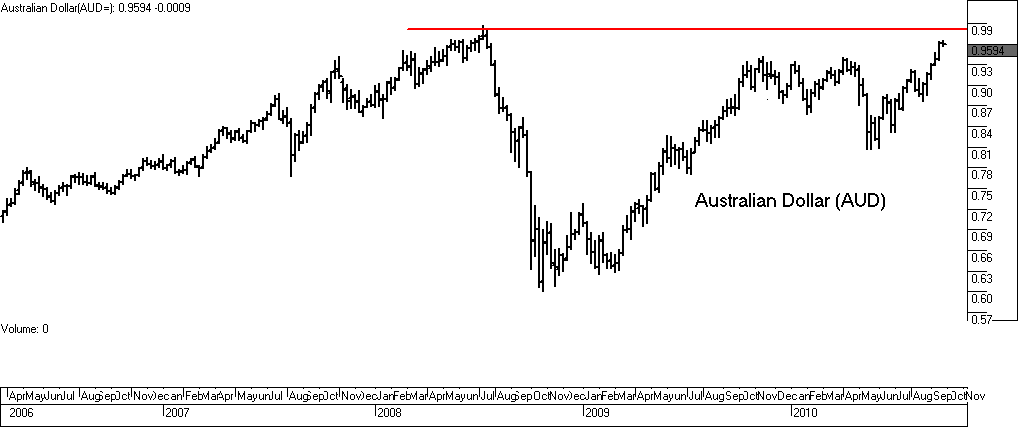
The Australian Dollar is trading around US96c after reaching a recent high of US96.15c – just 2c from the record high of US98.15c set in 2008. That’s impressive for a currency that was buying US81c in June this year after the Rudd Government announced plans for a Super Profits Resource Tax. So what does dictate the rise and fall of the Australian currency?
Fact: The Australian Dollar is the fifth most traded currency according the International Bank of Settlements.
Risk Adjusted Returns
The flow of corporate and investment capital is a key driver for all currencies. Generally, money will flow towards the place where is can generate the highest return on the lowest possible risk. This is the concept of risk adjusted returns. When Kevin Rudd announced plans for a new tax on Australia’s most profitable industry, the risk of investing in Australia rose significantly yet potential returns were unchanged. As a consequence, companies pulled the pin on Australian investments and the demand for Australian denominated assets declined – the Aussie dollar subsequently fell.
Since the introduction of the Gillard Government and the compromise on the mining tax, the concept of risk adjusted returns is now tilting back in Australia’s favour. The minority Government is unlikely to be effective in making any real changes to the current business environment and this is a positive from the perspective of an international investor.
Demand for Commodities
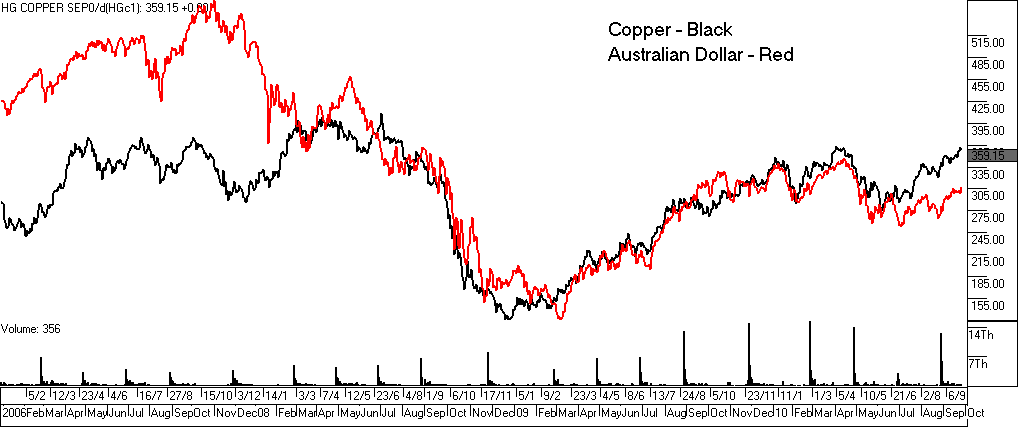
The increasing demand for commodities is supportive of a high Australian Dollar. To see this in action its worth looking at the high degree of correlation between the Australian Dollar and the Copper price. The outlook for Copper is incredibly strong with the metal trading near all time highs. Prices are supported by a lack of large scale supply coming online over the next five years and strong demand from emerging markets. This will have a positive impact on the Australian Dollar in the medium to longer term and could be the driver to push it through parity.
Interest Rate Differential
Benchmark Interest Rates in Australia are sitting at 4.5% and the minutes from the last RBA Board meeting suggest another rate rise in November, if not before. This contrast’s with US and UK interest rates sitting near zero - and it appears they’re unlikely to move higher any time soon. Capital looks for yield and the yield being achieved in the US is pretty dismal. US 10 year Treasuries are paying 2.6% compared to high quality Australian Banks that are paying yields of 5%+ with substantial scope for capital growth. Investors can borrow funds cheaply in the US, UK & Japan and invest in higher yielding markets such as Australia. Makes sense to me..!
Emerging Markets Growth
Australia is heavily leveraged to the growth in emerging markets. When I say growth, here are some figures to put this into context.
- There are now 170 Cities in China with 1 million + people
- In the last 30 years, 45% of the Chinese population have moved to cities - that’s 400 million people or 20 times the population in Australia
- This is mass urbanisation which has been built on rapid industrialisation
- The impact on the demand for raw materials is huge
- It takes 6 tonnes of Steel to build a 90m2 apartment - to make a ton of steel takes 1.7 tonnes of Iron Ore and half a tonne of Coking Coal -
- Australia has the resource to supply this insatiable demand and we’ve got quality companies taking advantage of this incredible trend.
All of the factors listed above offer strong reasons to explain the Aussie dollar strength. To cap it all off, we’re likely to see longer term structural weakness in the US currency based on record Government debt and high unemployment. This makes it almost impossible for policy makers to hike interest rates in an economy that will struggle for many years to come.
On the market last night, the DOW JONES lost -48 points or -0.44% to close at 10812. In the UK, the FTSE 100 lost -25 points or -0.45% to close at 5573. Locally, the SPI Futures are matching -18 points lower this morning.
